

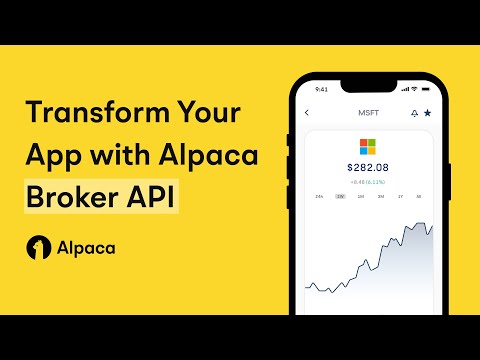
One of Alpaca’s standout features is its commission-free stock and ETF trading for U.S. markets. The broker provides access to fractional shares, allowing traders to invest with small amounts. Additionally, Alpaca supports paper trading, enabling users to test their strategies without financial risk. While it is mainly geared toward algorithmic traders, the broker has also attracted retail investors who appreciate its simplicity and zero-commission structure.
| Feature | Details |
| Founded | 2015 |
| Headquarters | United States |
| Trading Focus | Algorithmic trading via API |
| Asset Classes | U.S. Stocks, ETFs |
| Commissions | Commission-free trading |
| Fractional Shares | Available |
| Paper Trading | Yes |
| Regulation | FINRA, SIPC member |
Alpaca Trading’s streamlined API-first approach differentiates it from traditional brokers, making it a strong choice for traders looking to automate their strategies efficiently.
Minimum Deposit and Funding Methods
Alpaca Trading offers a straightforward deposit system, but it is essential to understand its funding requirements before getting started. The broker does not impose a minimum deposit requirement for standard accounts, allowing traders to start with any amount. However, if users intend to engage in margin trading, they must maintain a minimum balance of $2,000.
Traders can fund their accounts using bank transfers (ACH for U.S. clients) or wire transfers. ACH deposits are free but can take 3-5 business days to process. Wire transfers are faster, typically clearing within one business day, but they come with fees—domestic wires cost around $25, while international transfers can range between $35 and $50.
For withdrawals, the process is similar. ACH withdrawals are free but may take a few days to complete, while wire withdrawals incur fees. Additionally, Alpaca enforces a withdrawal limit on ACH transfers, typically allowing up to $50,000 per transaction.
Key Funding and Withdrawal Details
- Minimum Deposit: No minimum for standard accounts; $2,000 for margin accounts
- Deposit Methods: ACH transfers (U.S. only), wire transfers
- Deposit Fees: ACH – free; wire transfers – $25 (domestic), $35-$50 (international)
- Processing Time: ACH – 3-5 business days; wire – 1 business day
- Withdrawal Methods: ACH transfers, wire transfers
- Withdrawal Fees: ACH – free; wire withdrawals – standard banking fees apply
- ACH Withdrawal Limits: Up to $50,000 per transaction
Overall, Alpaca Trading offers flexible funding methods, but traders should be aware of processing times and fees, particularly for international wire transfers.
Security and Regulation
Alpaca Trading prioritizes security and regulatory compliance to ensure a safe trading environment for its users. The broker is registered with the Financial Industry Regulatory Authority (FINRA) and is a member of the Securities Investor Protection Corporation (SIPC). This means that client accounts are protected by SIPC insurance, covering up to $500,000 per customer, including $250,000 for cash balances, in case of broker insolvency.
Beyond regulatory oversight, Alpaca implements robust security measures to protect user data and funds. The platform uses bank-level encryption to safeguard transactions and personal information. Additionally, it supports two-factor authentication (2FA), adding an extra layer of security to prevent unauthorized account access.
Traders should note that while Alpaca offers strong internal security measures, the safety of trading strategies and algorithms depends on users’ own security practices. Since Alpaca primarily operates through APIs, it is crucial for traders to protect their API keys and use secure environments when running automated strategies.
Security Features of Alpaca Trading
- Regulation: Registered with FINRA, SIPC member
- SIPC Protection: Up to $500,000 per customer, including $250,000 for cash
- Encryption: Bank-level security for data and transactions
- Two-Factor Authentication: Available for enhanced account security
- API Security: Users must secure API keys and trading environments
Alpaca Trading’s compliance with FINRA and SIPC, combined with its advanced security features, provides traders with confidence in the platform’s reliability.
Trading Platforms
Unlike traditional brokers that offer desktop and mobile trading platforms, Alpaca Trading is designed specifically for API-based trading. This makes it an excellent choice for developers, algorithmic traders, and firms that rely on automated trading systems.
Alpaca provides a REST API, WebSockets, and Streaming APIs, enabling seamless order execution, real-time market data access, and portfolio management. The broker also supports multiple programming languages, including Python, JavaScript, and C#, making it accessible to a wide range of traders.
For those who prefer visual interfaces, Alpaca offers a web-based dashboard where users can monitor accounts, manage balances, and manually execute trades if needed. Additionally, the broker integrates with third-party platforms like TradingView and MetaTrader 5 (MT5), allowing traders to use charting tools and execute trades through familiar interfaces.
Supported Trading Platforms
- Alpaca API – REST API, WebSockets, and Streaming API support
- Programming Languages: Python, JavaScript, C#, and more
- Web-Based Dashboard: Basic account management and order execution
- TradingView Integration: Charting and trade execution
- MetaTrader 5 (MT5): Available for traders who prefer traditional platforms
While Alpaca’s API-first approach may not suit manual traders, it provides a robust infrastructure for algorithmic traders who seek flexibility and automation in their trading strategies.
Trading Accounts at Alpaca
Alpaca Trading offers different account types to cater to various trading needs. The broker provides individual brokerage accounts, margin accounts, and corporate accounts, each designed for different levels of trading experience and capital requirements.
- Individual Brokerage Account – This is a standard account that allows commission-free trading of U.S. stocks and ETFs. It supports fractional shares and paper trading, making it suitable for beginners and algorithmic traders testing their strategies.
- Margin Account – For traders looking to leverage their capital, Alpaca offers margin accounts with a minimum balance requirement of $2,000. This account allows users to borrow funds to trade on margin, potentially increasing gains (but also risks).
- Corporate Accounts – Designed for businesses and trading firms, these accounts provide access to Alpaca’s trading infrastructure with higher funding limits and additional features tailored for institutional trading.
Key Features of Alpaca Trading Accounts
| Account Type | Features and Benefits |
| Individual Account | No minimum deposit, commission-free, fractional shares, API access |
| Margin Account | Requires $2,000 minimum, allows margin trading, higher buying power |
| Corporate Account | Tailored for businesses, higher funding limits, API integration |
Choosing the right account depends on the trader’s goals. Beginners and API traders may opt for the individual account, while active traders seeking leverage should consider the margin account. Business entities can benefit from the corporate account’s flexibility.
Conclusion
Alpaca Trading stands out as a commission-free, API-driven broker designed for algorithmic and quantitative traders. Its advanced infrastructure, fractional share trading, and regulatory compliance make it an attractive choice for developers and active traders seeking automation.
Pros and Cons of Alpaca Trading
| Pros | Cons |
| Commission-free trading | No traditional trading platform |
| API access for algorithmic trading | Limited asset classes (stocks, ETFs) |
| Fractional shares available | No options or futures trading |
| SIPC insurance protection | Margin trading requires $2,000 minimum |
| Integration with TradingView and MT5 | ACH and wire withdrawals have limits and fees |
While Alpaca Trading may not be ideal for traditional traders looking for a full-featured desktop platform, it is an excellent choice for those seeking automation, API integration, and commission-free stock trading. With strong security measures and regulatory oversight, it offers a reliable environment for modern traders.